
There are beaches that dazzle and beaches that seduce. Plage de la Garoupe does neither — at least not obviously. It does something rarer. It endures.
Tucked into the eastern curve of Cap d’Antibes, between Antibes and Juan-les-Pins, this crescent of pale sand has been quietly shaping Riviera mythology for over a century. It has watched fashions change, fortunes rise and fall, writers come and go, yachts grow larger and sunglasses grow darker. And still, it remains unmistakably itself.
On a coastline famous for spectacle, La Garoupe whispers.
The Peninsula That Refused to Perform
Cap d’Antibes is a geography of restraint. The peninsula stretches into the Mediterranean like a long green thought, edged with limestone shelves and shadowed by umbrella pines that tilt toward the water as if permanently considering a swim. The scent here is salt and resin and something faintly sweet — wild fennel crushed beneath sandals.
Unlike Cannes, where the Croisette hums with camera flashes, or Saint-Tropez, where beach clubs pulse with curated hedonism, Cap d’Antibes has always guarded its mystique. Its glamour is archival rather than performative. It does not reinvent itself each season. It simply persists.
Behind high walls softened by bougainvillea, Belle Époque villas sit in contemplative silence. Cypress trees punctuate the skyline. Shuttered façades fade gently under decades of sun. If you drive slowly along the narrow roads that thread the peninsula, you’ll glimpse wrought-iron gates and terraced gardens, but rarely more. Privacy is part of the landscape.
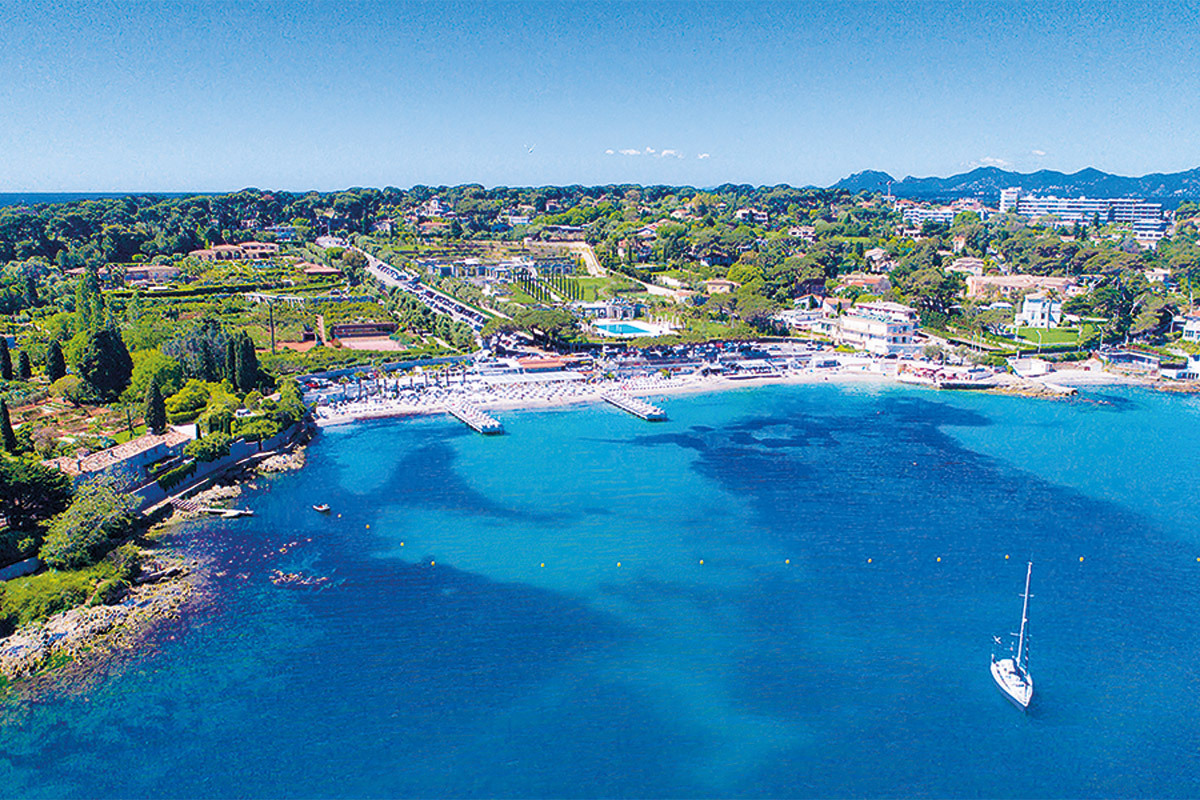
And then, almost unexpectedly, the trees open and the sea appears — and there, in its protected bay, lies La Garoupe.
A Curve of Light
The beach is smaller than one imagines. That is part of its charm.
A pale crescent arcs gently inward, held between rocky outcrops and backed by pines that filter the afternoon light into gold. The Mediterranean here is unusually clear, the kind of clarity that feels theatrical, though nothing about the setting is staged. At the shoreline, the water is transparent jade. A few metres out, it deepens into a languid turquoise. Farther still, it turns the inky blue of old Riviera postcards.
The sand is soft underfoot — a rarity along this rugged stretch of coast where limestone more often dominates. It shelves gradually, inviting swimmers to wade slowly, then float. There are no abrupt drops, no drama. Even the sea seems to understand the peninsula’s temperament.
In the early morning, the beach belongs to locals. A woman in a straw hat walks the waterline with a small dog. A man performs steady, meditative laps out toward the anchored boats. Towels are shaken out with gentle precision. Espresso cups appear from woven bags.
By midday, La Garoupe fills — but never overwhelms. There is movement, certainly. Laughter drifts across the sand. Children build precarious castles at the edge of the tide. Waiters navigate sunbeds with quiet choreography. Yet the atmosphere remains calibrated.
It is lively without being loud. Sociable without being seen.
The Jazz Age Found Its Shoreline
La Garoupe’s quiet magnetism first crystallised in the 1920s, when Cap d’Antibes became a summer refuge for a new kind of international elite — artists, writers, aesthetes who sought light as much as leisure.
Gerald and Sara Murphy arrived with modern sensibilities and a talent for hospitality. Their villa became a gathering place for a circle that included F. Scott Fitzgerald, who absorbed the rhythms of the Riviera and later translated them into prose that still shimmers with sunlit melancholy.
The Murphys and their guests did something radical for their time: they embraced the sun.
In an era when pale skin still signified privilege, bronzed limbs suggested freedom. They swam in the morning, lunched outdoors, let the day expand without apology. The ritual of beachgoing became less about utility and more about aesthetic — linen trousers, striped parasols, the choreography of idleness.
La Garoupe was the stage for this transformation. Here, leisure became art.
Even now, on certain afternoons when the light slants just so and the sea lies impossibly flat, it is easy to imagine Fitzgerald watching the horizon, notebook resting on his knee.
The Beach Clubs: Riviera in Miniature
Part of La Garoupe remains public, open to anyone willing to arrive early enough to secure a towel’s width of sand. But much of its rhythm is shaped by its beach clubs — not brash, not experimental, but quietly assured.
Sunbeds align in disciplined rows. Parasols bloom overhead in neat repetition. The aesthetic is not one of excess but of order. Service unfolds with gentle efficiency — a chilled bottle of rosé appearing before you realise you were thinking of it, a linen napkin laid just so.
Lunch is the day’s centrepiece.
It begins slowly. A table under shade. The faint percussion of cutlery against porcelain. The scent of grilled fish carried on warm air. Tomatoes taste impossibly ripe. Olive oil glows green-gold in shallow dishes. Sea bass arrives whole, flesh delicate and fragrant. There may be grilled prawns, simply dressed in lemon. A crisp fritto misto. Always, there is bread — torn, dipped, shared.
Time loosens its grip here. Conversations stretch. Phones are set aside. A second bottle is ordered. Perhaps a third.
Afternoon drifts toward languor. Some guests return to the sea, sliding into the coolness to reset sun-warmed skin. Others retreat to their sunbeds, wide-brimmed hats tilted low. The Mediterranean becomes backdrop and participant all at once.
Villas Behind the Pines
The beach does not exist in isolation. It is part of a larger ecosystem of discretion.
Behind La Garoupe, the peninsula rises gently, and within its folds are villas that have witnessed a century of Riviera summers. Architectural styles vary — Florentine flourishes beside Art Deco minimalism — but the common thread is seclusion.
High walls are softened by ivy. Gates are rarely open. Gardens spill with oleander and lavender. From certain angles, you might glimpse a terrace overlooking the sea, a long dining table set for an evening gathering.
Ownership here is often generational. Families return year after year, occupying the same bedrooms, the same shaded corners of the garden. Stories accumulate. Children become adults who bring children of their own.
The continuity is palpable.
Unlike other Riviera enclaves that pivot toward novelty, Cap d’Antibes has remained faithful to its original character. It has not chased reinvention. It has simply allowed time to layer itself gently across stone and sand.
The Yachts at Anchor
Offshore, yachts rest in the sheltered bay, their hulls reflecting fractured light. They are present but never intrusive.
In Saint-Tropez, yachts line up like declarations. In Monaco, they form part of the skyline. At La Garoupe, they anchor with a kind of etiquette — close enough to suggest arrival, far enough to preserve the view.
Tenders glide quietly toward shore. Guests disembark with minimal fuss. A swim platform breakfast gives way to a beachside lunch. Later, as the sun begins its descent, they return to deck for aperitifs while the peninsula darkens into silhouette.
The anchorage feels less like a parade and more like a pause.
The Climb to the Lighthouse
As afternoon mellows, there is a small ritual that regulars understand instinctively: the walk to the lighthouse.
The path winds upward through pines, scented and shaded. Cicadas pulse in the undergrowth. The sea flickers intermittently through branches until, finally, the view opens.
From this height, the Mediterranean stretches in every direction. To the west, the curve of the Bay of Angels glows. Offshore, islands hover like mirages. The horizon feels infinite.
Sunset here is not theatrical; it is immersive. The sky softens from blue to apricot to rose. The sea absorbs each hue. Church bells sometimes drift upward from the peninsula below.
It is a moment of recalibration — the kind that lingers long after the light has gone.
What La Garoupe Is Not
To understand La Garoupe fully, one must also consider what it resists.
It is not driven by nightlife. There are no choreographed champagne rituals, no thundering DJ sets at midday. It does not thrive on celebrity exposure. You may recognise a face or two — a discreet film director, perhaps, or a novelist escaping a deadline — but they blend easily into the broader tapestry.
La Garoupe values presence over performance.
In a region where visibility often equates to relevance, that choice feels almost radical.
The Luxury of Slowness
Ultimately, the power of Plage de la Garoupe lies in its pacing.
There is something about the curve of the bay, the filtered light beneath the pines, the rhythm of long lunches and longer swims, that invites a different kind of attention. You begin to notice small things — the texture of sand beneath your heel, the faint hiss of waves at the shore, the way rosé tastes cooler after a swim.
The beach does not demand anything from you. It does not insist you document it. It does not try to impress.
Instead, it offers permission.
Permission to linger.
Permission to watch the horizon without agenda.
Permission to inhabit the present moment without spectacle.
In an age defined by acceleration, that may be its most radical gesture.
The Enduring Allure
Nearly a century has passed since Fitzgerald’s circle reimagined sunlit leisure on these sands. The world has shifted dramatically since then. Yet La Garoupe remains — calibrated, luminous, unhurried.
Children still chase the tide. Waiters still carry trays with quiet assurance. Yachts still rock gently at anchor. The lighthouse still casts its steady beam across dark water.
The peninsula continues to guard its privacy. The beach continues to welcome those who understand its language.
La Garoupe does not chase trends. It does not seek reinvention. It simply holds its line against time and tide.
And as dusk settles over Cap d’Antibes — the sky fading to indigo, the sea darkening to velvet — one realises that the beach’s greatest seduction is not its beauty, nor its history, nor even its glamour.
It is its constancy.
On a coastline that dazzles and reinvents and performs, Plage de la Garoupe remains what it has always been:
A quiet curve of light.
To plan a luxury yacht charter in France, please contact:


